How an Investigator Exposed a $1.3M Staged Claim Without Leaving Her Desk
A long-term disability claim looked airtight on paper. Here's how a single investigator used Expose to find the public footprint that quietly contradicted every word of it.
On this page
A claim with no loose ends
The file that landed on Dana desk was, by the standards of her job, almost boring. A claimant in his late forties - we'll call him Trevor - had filed a long-term disability claim after a back injury he said left him unable to work, lift, or sit for more than a few minutes at a time. The medical documentation was thorough. The physician statements were consistent. The math, over the remaining years of the policy, came to roughly $1.3 million in payouts. Everything was in order.
Dana had spent eleven years investigating claims for a regional insurer, long enough to distrust files that were too tidy. Not because tidiness proves fraud - most clean files are clean because the claim is real - but because the genuinely fraudulent ones are often the most polished. A real injured person is messy and inconsistent in the human way; a coached one has rehearsed. Something about the symmetry of Trevor's file made her want a second opinion that didn't come from inside the file itself.
So she did what the file couldn't do for her. She opened Expose and went looking for the version of Trevor that existed in public.
The gap between the claim and the world
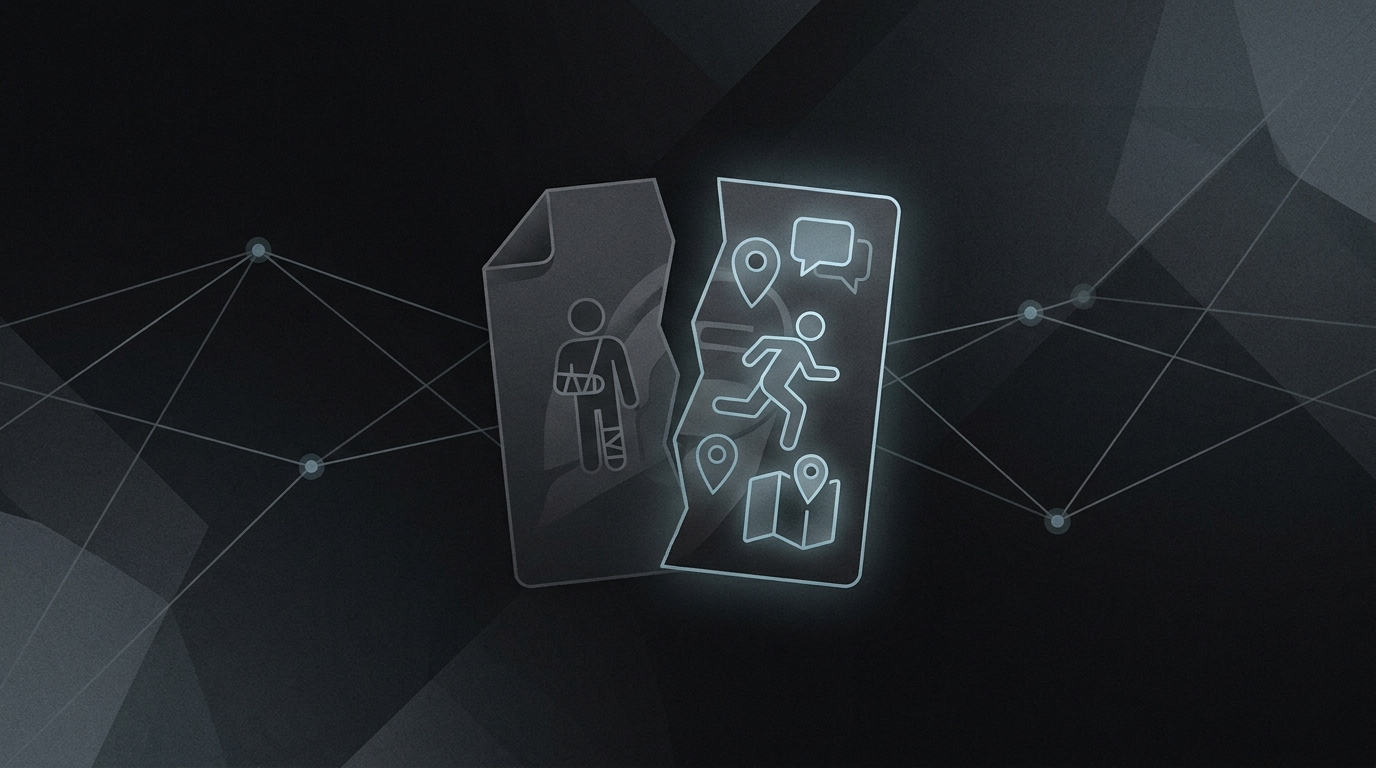
Dana's job was not to surveil anyone. It was to compare two pictures: the one painted by the claim, and the one painted by the open record. If they matched, the claim was almost certainly real and she'd close it as legitimate, which is how most of her files end. If they diverged - if a man who couldn't sit for ten minutes was publicly doing something a man who couldn't sit for ten minutes can't do - that gap was the whole case.
She started with Trevor's name, approximate age, and city, and used Expose to build a footprint. The platform pulled together what was already scattered across the open internet: business registrations, social profiles under his name and common variants, public posts, marketplace listings, and the digital exhaust of an ordinary life. Most of it was unremarkable. One thing was not.
"I'm not looking for a smoking gun on day one," Dana said. "I'm looking for the seam where the story they're telling stops matching the life they're actually living. The seam is almost always public. People perform their real lives online far more honestly than they perform their claims."The business he didn't mention
The first seam was a business registration. Filed eight months after the date of his claimed injury, in a name that paired Trevor's middle name with his wife's maiden name, was a registration for a small landscaping and hardscaping company - the kind of work built almost entirely on lifting, bending, and standing for hours. On its own, a registration proves nothing; people start businesses they don't physically work in. But it was a thread, and Dana pulled it.
Expose connected the business to a public social page promoting its services. The page was a problem for Trevor. It carried photos - some of them clearly featuring him - of completed projects: retaining walls, paver patios, hauled stone. The captions, written in the first person, described the physical work in proud detail. The posting dates fell squarely inside the period he was certifying, in signed medical paperwork, that he could not lift or sit. The man in the claim and the man on the landscaping page could not both be telling the truth.
Corroboration, not a single screenshot
Dana knew better than to hang a $1.3 million decision on one social page. Pages can be stale. Photos can be old, staged, or someone else entirely. A single contradiction is a lead, not a conclusion. She used Expose to corroborate - to find whether the same story showed up across independent sources that wouldn't all conveniently lie in the same direction.
It did. The pieces stacked up:
- a marketplace listing where the business advertised "same-week installs," posted and updated during the claim period;
- customer reviews on a separate platform, dated within the window, describing Trevor by name doing the work on-site;
- a local community group post recommending "Trevor's crew," with a photo of him on a job;
- a phone number on the business page that traced back, through Expose, to Trevor's known contact details on the claim file.
That last link mattered most. It closed the loop between "a landscaping business that happens to share a name" and "the specific claimant in front of me." The phone number on the public ads was the same number Trevor had given his own insurer. The two pictures - the disabled claimant and the working contractor - were unambiguously the same man.
What the investigator was careful not to do
This is the part of the story that separates responsible investigation from a privacy violation. Dana did not surveil Trevor's home. She did not contact his family, pose as a customer, or pull anything that wasn't already published to the open public by Trevor or his customers themselves. Every artifact she used was open-source - posted voluntarily, indexed publicly, available to anyone who knew where to look. Expose's role was speed and correlation, not access. It read the public record faster and more completely than a human flipping between a dozen sites, but it read only what the public could already see.
She was equally careful about her conclusion. OSINT surfaces leads; it doesn't render verdicts. What Dana had was not "proof of fraud" in a courtroom sense - that determination belongs to a claims committee and, if it goes that far, to a court. What she had was a thoroughly documented, independently corroborated contradiction between the claimant's sworn limitations and his publicly advertised physical labor, with the identity link nailed down. That was the trigger for the next legal step, not the verdict itself.
Building a file that holds up
A finding is only as good as the documentation behind it, and insurance fraud findings get challenged hard. Dana exported a structured report from Expose capturing each source, its public URL, and the date she captured it, so the evidence was contemporaneous rather than reconstructed from memory. She preserved the original posts and listings before they could be quietly deleted - a routine precaution, because the first thing a claimant does when challenged is scrub their public footprint.
She also documented the things that didn't support the case, because an honest file includes them. A couple of the photos were ambiguous as to date. One review might have referred to a relative. She flagged those rather than overstating them. The strength of the case didn't depend on any single artifact; it depended on the weight of many independent sources all pointing the same way, with the contradictions noted in the open.
"The fastest way to lose a fraud case is to oversell it," Dana said. "If I claim ten things and one is shaky, opposing counsel spends the whole hearing on the shaky one. I'd rather bring eight solid things and call the two soft ones soft. Credibility is the asset."How it resolved
Presented with the documented file, the insurer's special investigations unit took it from there through proper channels - a formal review, a request for additional medical examination, and the legal process that governs contested claims. Dana's job was to surface and document the contradiction cleanly; the adjudication was someone else's. The claim did not pay out as filed. The broader matter was referred for the kind of scrutiny that staged claims invite once the public record stops cooperating with the story.
Just as importantly, the case sharpened how Dana's team worked the rest of their files. The point was never to assume claimants are lying - the overwhelming majority aren't, and treating honest injured people like suspects is both cruel and bad business. The point was that a fast, open-source cross-check costs little time and either clears a clean claim with confidence or flags the rare staged one before it pays. Most checks came back confirming the claim was exactly what it said it was. That outcome is a feature, not a failure - it's how a good control should feel.
Expose's contribution wasn't access to secrets. It was the speed to set the two stories on one table before $1.3 million quietly walked out the door. The contradiction had been public the entire time. The difference was simply the will to look, and a way to look quickly enough for it to count.
Could you cross-check a claim against the public record in minutes?
Expose turns a name, number, or business into a connected footprint - so clean claims clear fast and staged ones surface before they pay.