How Expose Traced a Crypto Romance Scam Back to the People Who Built It
A retired teacher had sent $210,000 to a man she had never met. Here's how her daughter used Expose to dismantle the fiction - and follow the money to the people who built it.
On this page
A man who only existed in messages
Elaine had been a high-school chemistry teacher for thirty-four years. She was not naive, and she did not consider herself the kind of person who fell for things. So when her daughter, Robin, first heard the name "David Whitmore," she didn't worry much. Her mother had mentioned, almost shyly, that she'd been talking to a kind man she met in a hobby group online - a widowed civil engineer working on an offshore project, warm and attentive and unhurried. They had never video-called; the rig had bad connectivity, he said. They had never met; his work kept him at sea for weeks. But they texted every day, sometimes for hours.
The worry started the afternoon Robin noticed her mother was quietly anxious about money - a woman who had always been careful, suddenly vague about her savings. Over a long, gentle conversation, the picture came out. There had been a customs fee David needed help with to release his equipment. Then a medical emergency for his daughter at boarding school. Then a bridge loan to free up a contract payment that was, he promised, days away. In four months, in a dozen transfers, Elaine had sent $210,000 to accounts and crypto wallets she could no longer fully account for.
Robin did not lecture. She opened Expose.
The first crack: a face that belonged to someone else
Robin started with the only images she had: three photographs "David" had sent over the months - a profile shot, a picture in a hard hat on what looked like an industrial deck, and a casual one at a café. They were the emotional core of the relationship, the proof, in Elaine's mind, that he was real. Robin ran a reverse-image search through Expose.
The results were quiet and devastating. The "David" in the café photo was a Portuguese fitness instructor with a public, years-old social presence under an entirely different name. The hard-hat photo had been lifted from a stock-style gallery attached to an unrelated engineering firm's website. The third image appeared on two other dating-scam warning pages where victims had posted the same face under three different identities. The man Elaine loved was a collage - assembled from strangers who had no idea their pictures were being used to break someone's heart and bank account.
"I didn't want to be the one to show her," Robin said. "But the photos weren't an opinion. They were a fact. You can argue with your daughter. You can't argue with the same face wearing three names."Following the thread the scammer left behind
Proving "David" wasn't real was the easy part. The harder, more useful question was: who actually took the money? A face can be stolen. Infrastructure has to be paid for, and payment leaves trails. Robin gathered every concrete artifact her mother still had: the phone number David texted from, the email address on his "invoices," and the wallet addresses and bank details from the transfers.
She fed them into Expose one by one and asked the platform to do what a person can't do quickly: correlate. The phone number was a VoIP line registered through a reseller - cheap, disposable, and tellingly tied to two other numbers used in the same window. The email address, seemingly anonymous, surfaced in an archived domain registration for a generically named "logistics" company, and that registration carried a second contact email the operator had forgotten to scrub. That second address was the loose thread.
Run through Expose, the forgotten address connected to:
- a cluster of look-alike "shipping" and "engineering contract" domains, all built from the same template;
- a marketplace seller account with a partial real display name and a years-old delivery city;
- an entry in a public breach corpus that paired the address with a reused password and a recovery phone number;
- a social profile, long abandoned, that the operator had clearly never imagined anyone would tie back to "David."
None of it was hidden. It was simply scattered across a dozen corners of the open internet, in the gaps between databases no single person could check by hand. Expose read those corners at once and laid the fragments on one table.
The money was the map
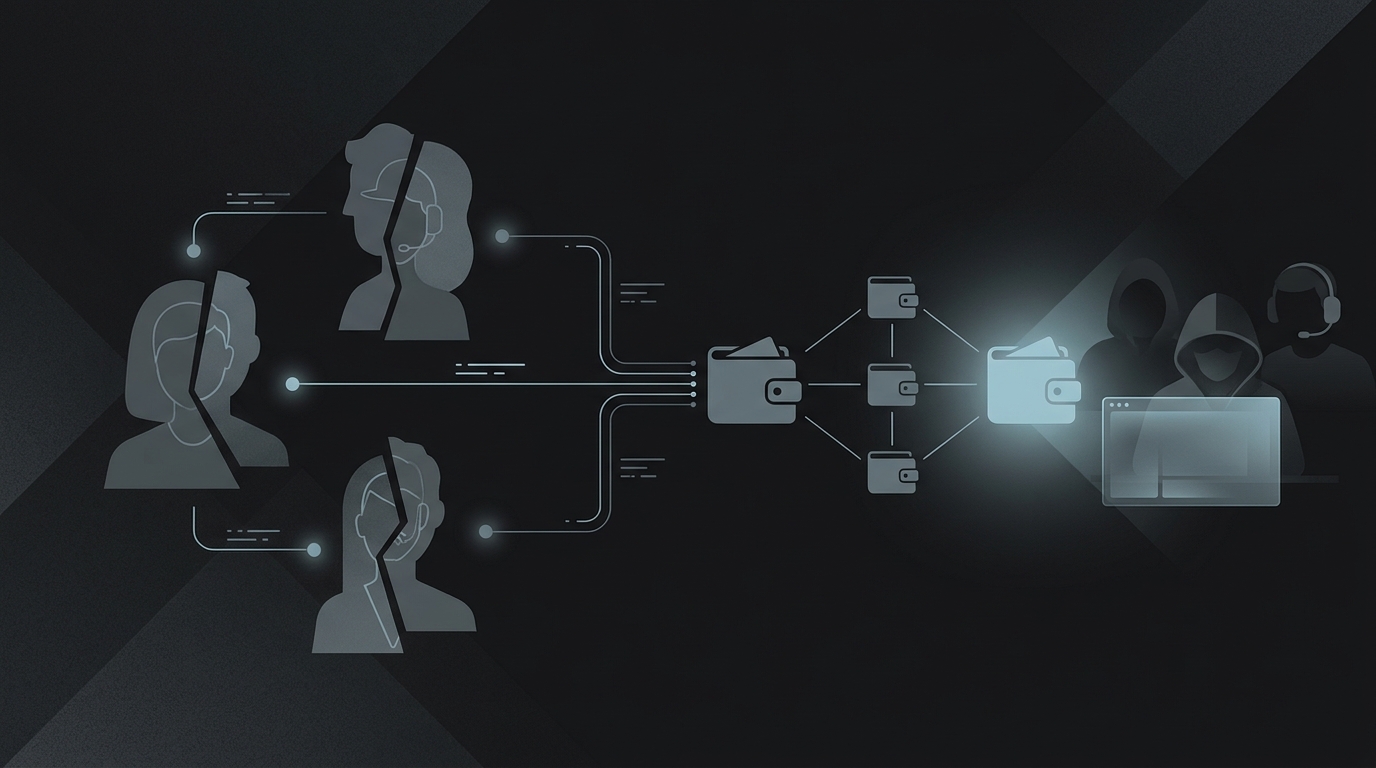
The crypto transfers turned out to be the clearest signal of all. Public blockchains are exactly that - public. The wallet Elaine had sent funds to wasn't a dead end; it was a node. Robin traced the on-chain flow and found that her mother's payments had been pooled with funds from other wallets, then funneled through a familiar laundering pattern toward a small set of exchange deposit addresses.
The shape of it told the story. This was not a lonely man improvising lies from an oil rig. It was a collection operation - multiple victims, the same consolidation wallets, the same off-ramps, the same disposable infrastructure registered in the same narrow windows. Elaine was not "David's" only relationship. She was one entry in a pipeline.
"The moment I saw other people's money flowing into the same wallets, it stopped being about my mom's bad judgment," Robin said. "It became obvious this was a machine, and she'd been fed into it like everyone else."The conversation, and the report
Robin chose her moment carefully. Romance scams work because they hijack genuine emotion, and the cruelest part is that exposing them can feel, to the victim, like a second betrayal - now by the person they trusted to help. She didn't lead with "you were fooled." She led with the evidence, slowly, and let her mother arrive at it herself: the same face under three names, the money flowing in with strangers' money, the eleven-day-old domains pretending to be a decades-old career.
Elaine cried, and then she got angry, which Robin took as a good sign. Together they did the unglamorous, important things. They stopped all contact and all payments immediately. They preserved everything - exported a structured report from Expose, saved the message history, and compiled the transaction records before anything could be deleted. They filed reports with the national fraud center and the FBI's complaint portal, attaching the wallet trail and infrastructure findings. They flagged the exchange deposit addresses to the relevant platforms, which can sometimes freeze funds if they move fast enough.
Most of the $210,000 was gone - that is the honest, hard truth of these cases. But a portion still sitting at an exchange off-ramp was frozen pending investigation, and the documented cluster fed into an existing law-enforcement case touching several other victims. Elaine's loss became evidence in something larger than her own grief.
The quiet lesson
There's a version of this story where the moral is "be more suspicious," and it's not a very useful one - Elaine was a smart woman who simply wanted to believe someone cared. The more honest lesson is that love and loneliness are not character flaws, and that the defense against people who weaponize them isn't cynicism. It's the ability to look, quickly and clearly, at the few hard facts a fiction can't hide: a borrowed face, a too-new domain, money flowing where money shouldn't.
"David Whitmore" never existed. The people who built him did, and a portion of the trail they left led somewhere real. The data that exposed them had been sitting in the open the whole time. What changed everything was a daughter who decided to look - and a way to look fast enough for it to count.
Could you tell a real person from a borrowed one in under a minute?
Expose turns a single photo, wallet, or phone number into a connected intelligence picture - before the next transfer goes out.