How a Probate Researcher Found the Missing Heir to an Unclaimed Estate
A man died with no will and no known family, and a modest estate that would have gone to the state. Here's how a probate researcher used Expose to reconstruct a scattered family tree and find the heir who never knew.
On this page
An estate with no one to claim it
The file that came to Lucas was the kind that usually ends in silence. A man - we'll call him Walter - had died in a small apartment with no will, no spouse, no children anyone knew of, and no family that had come forward. He'd kept to himself for decades. His modest estate, a lifetime of careful saving, sat in legal limbo. If no heir could be found, it would eventually escheat - pass to the state by default, the legal endpoint for the property of people who die seemingly alone.
Lucas was a probate researcher, sometimes called an heir hunter, though he disliked the term's treasure-hunting connotation. His work was genealogical detective work with a clock running: reconstruct the family of someone who died without obvious heirs, and find the living relatives legally entitled to inherit - people who, very often, have no idea the deceased existed. "Alone" on a death certificate rarely means alone in the world. It usually means disconnected, and disconnection leaves a trail. He opened Expose and started with the only thing he had: a name, a date of birth, and a last address.
Working backward through a life
Genealogical research for probate runs in two directions. First you go backward and outward - reconstructing the deceased's parents, siblings, and extended family - and then you come forward again, tracing those branches down to whoever is alive today. The whole structure rests on public records: birth, marriage, and death records, census data, property and address history, obituaries, and the documentary residue of an ordinary life. The challenge is never that the records don't exist. It's that they're scattered across decades, jurisdictions, name variants, and archives that don't talk to each other.
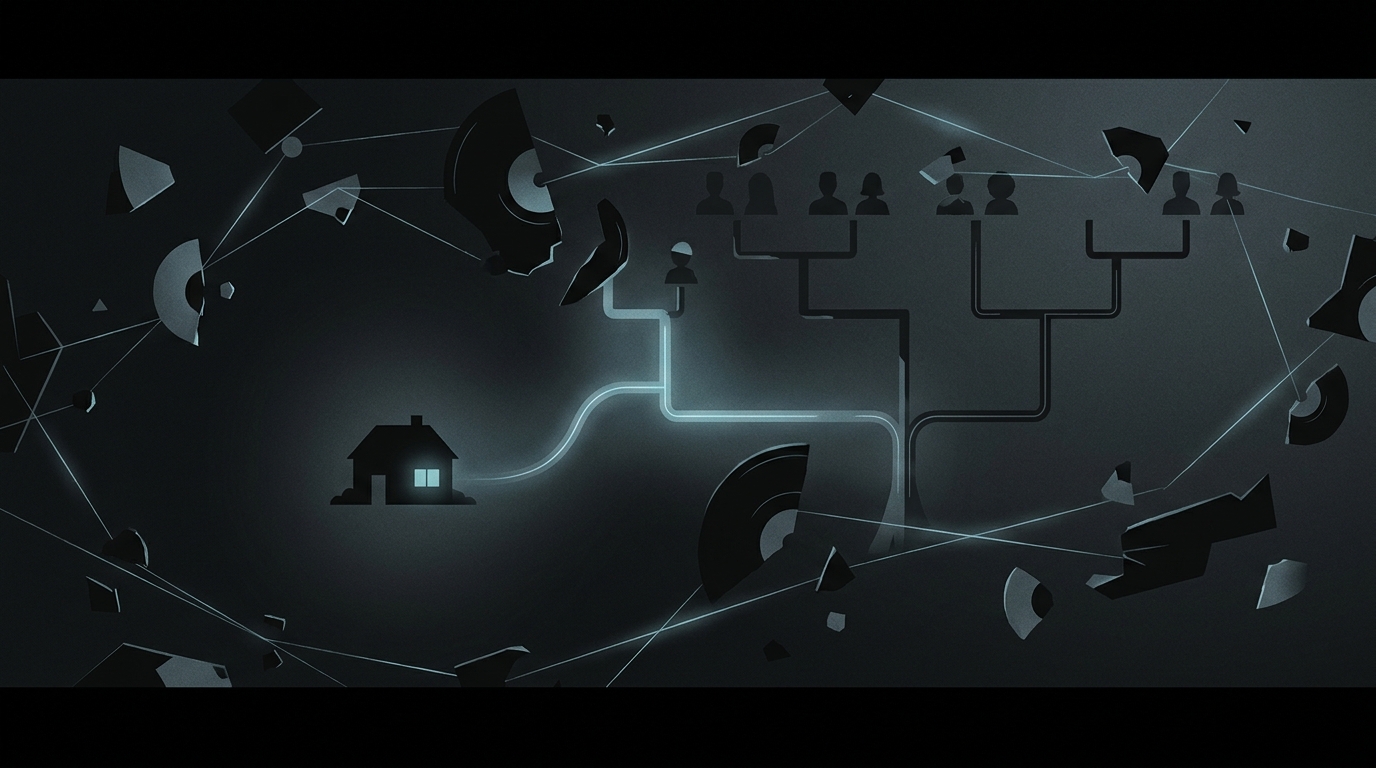
Lucas used Expose to do what would otherwise mean weeks of writing to county offices and squinting at microfiche: correlate the fragments of Walter's life across sources, fast. From the name and date of birth, the platform helped him assemble a skeleton - earlier addresses, a long-ago marriage record, the names that appeared alongside his across the decades. Walter, it turned out, had not always been solitary. The isolation was the last chapter, not the whole book.
The records placed Walter, decades earlier, in a different state, with a family around him:
- a marriage that had ended early, with no children from it;
- two siblings, both of whom had since died - one of them, crucially, after raising a family;
- a mother whose maiden name opened up an entire branch the surname alone had hidden;
- a scattering of address moves that explained how Walter had drifted out of contact with all of them.
None of this was secret. Each fact lived in a different public record - a marriage license here, an obituary there, a census entry, a property record. The trick that would have taken a human researcher weeks of jurisdiction-hopping, Expose performed as a correlated reconstruction, turning a man who "had no family" into a man with a documented, if long-fractured, one.
Coming forward to the living
The deceased sibling who had raised a family was the thread that led to a living heir. Lucas followed that branch forward - from Walter's late brother, to the brother's children, to whoever among them was alive today. This is where reconstruction gets delicate: names change with marriage, people move across the country, and a single transcription error in an old record can send a researcher chasing the wrong person entirely.
He used Expose to trace the brother's line down through the years, cross-referencing each generational step against multiple independent records so he wasn't building on a single shaky link. The trail led to a nephew - Walter's brother's son - now middle-aged, living several states away, who by the laws of intestate succession was very likely the rightful heir to an uncle he had, in all probability, never met or even heard of. Lucas confirmed his identity and his connection to Walter across several corroborating public sources before he was willing to believe her own conclusion.
The call that came out of nowhere
There's an unavoidably human moment in this work that no amount of record-correlation prepares you for: telling someone that a relative they never knew has died and left them an inheritance. Lucas had learned to do it gently. A cold call announcing a death and money sounds, understandably, exactly like a scam - because that specific pitch is a common scam - so he led with verifiable facts the real nephew could check independently, moved slowly, and gave him every opportunity to confirm his legitimacy before anything else.
The nephew was, as most people in his position are, stunned. He had a vague, secondhand memory of an uncle who had "moved away and lost touch," a half-story from his late father, nothing more. He had never known Walter was still alive, let alone that he had died, let alone that he was Walter's heir. With the documented family tree as the foundation, the matter proceeded through probate the way it's supposed to: formal verification, the court's determination of heirship, and ultimately the estate passing to the living relative it belonged to - rather than escheating, by default, to the state.
Walter's life savings went to his family. That sentence is the entire point of the work, and it's easy to lose under the mechanics of records and statutes. A man who died seemingly alone turned out not to be alone at all - just disconnected. And the disconnection, it turned out, was reversible from the public record.
Why the heir was 'missing' at all
It's worth understanding why someone like Walter ends up with "no known family" in the first place, because the reasons are mundane and common. People move and don't leave forwarding trails. Surnames obscure maternal lines, so an entire branch becomes invisible if you only follow the obvious name. Families fracture quietly - not through dramatic estrangement but through drift, distance, and the slow erosion of contact across decades. A person can be deeply embedded in a documented family history and still die in an apartment where no one knows their relatives' names.
What made the heir findable was not luck. It was the fact that a disconnected life still leaves a connected record, and that the record, scattered as it was, could be reassembled. The marriage license, the sibling's obituary, the mother's maiden name, the chain of addresses - each fragment had been sitting in the open for years. What defeated the default of escheatment was the ability to gather those fragments across decades and jurisdictions fast enough, and accurately enough, to build a tree a court could trust.
The quiet lesson
There's a sentimental version of this story about a lonely man and a long-lost family, and it's not wrong, exactly - but the more useful truth is quieter. Walter wasn't found because of fate or a dramatic deathbed revelation. He was found because the ordinary documents of a life - a marriage, a sibling, a mother's maiden name, a string of addresses - persist in the public record long after the connections between people fall away, and because those documents can be reassembled by someone patient and careful enough to do it right.
The family that "didn't exist" had been documented in the open the entire time, waiting in records nobody had thought to connect. The difference was a researcher who refused to accept "died alone" as the end of the story, who confirmed every link before he trusted it, and who had a way to reconstruct a scattered life quickly enough to reach a living heir before an estate disappeared into the state's coffers.
Could you reconstruct a scattered family tree from a single name?
Expose cross-references records, addresses, and connections across decades - so a missing heir can be found before an estate quietly escheats to the state.